



















You’ve finalized a construct, submitted it for synthesis, and learned it may be difficult to manufacture. That can be frustrating, but it does not always mean starting over. Often, the issue traces back to sequence features such as very high or very low GC content, frequent repeats, stable secondary structures, or challenging terminal regions. This guide can help you identify the likely cause and choose a practical path forward.
What makes a DNA sequence difficult to synthesize?
Some constructs contain features that make synthetic DNA assembly harder, including GC-rich or GC-poor regions, repeated patterns, stable secondary structures, and difficult sequence composition near the 5' or 3' end. In many cases, targeted design changes can improve manufacturability while preserving the intended biological function. Complexity screening tools can help identify many of these features, but because synthesis outcomes may be influenced by combinations of sequence characteristics, a low predicted complexity score should be interpreted as a useful design guide rather than a guarantee of manufacturing success.
Start here: Choose the best next step
The right approach depends on where the challenging features appear, whether the sequence can be modified, and how the construct will be used. Start by locating the difficult region, then match that pattern to the strategies below.
Designing a positive qPCR control?
Positive qPCR controls may require a different redesign approach because assay-critical regions often need to remain unchanged. When synthesis challenges occur, consider preserving target, primer, and probe-binding sequences while evaluating whether non-essential flanking regions can be modified to improve manufacturability.
- If difficult features are spread across a coding sequence: consider codon optimization to adjust sequence composition while preserving the intended protein sequence.
- If difficult features are distributed across the construct: splitting the sequence into smaller fragments may reduce the synthesis burden by separating challenging regions and making each fragment easier to manufacture and assemble.
- If a highly complex feature is concentrated in a small region: consider isolating that region for more targeted redesign, an alternative synthesis format, or sourcing the sequence from an existing template if sequence changes are not possible.
- If high- or low-GC content appears near the 5' or 3' end: revising the terminal-end design may help reduce synthesis challenges for linear DNA fragments.
- If the sequence remains difficult as a standard fragment: a cloned gene or gBlocks™ HiFi Gene Fragment may be a better fit. These formats use different synthesis and verification workflows, which are more robust against most types of complexities that don't involve high GC content.
- If downstream cloning or expression requirements are fixed: choose the option that preserves critical features such as restriction sites, assembly overlaps, reading frame, tags, and regulatory elements.
Compare your troubleshooting options
| Strategy | Best used when | What it may help address | Key consideration |
|---|---|---|---|
| Codon optimization | Difficult features are distributed across a coding sequence | Extreme GC content, rare codons, repeats, and other synthesis-limiting patterns | Confirm the optimized sequence still preserves the intended protein sequence and any required nucleotide-level features. |
| Split into smaller fragments | Difficult features are distributed across the construct or separated by lower-complexity regions | Long repeats, dispersed GC challenges, widespread sequence complexity | Whenever possible, place fragment junctions in lower-complexity regions to support both synthesis and downstream assembly. |
| Isolate highly complex regions | A particularly difficult feature is concentrated within a limited portion of the sequence | Dense repeats, highly structured regions, extreme localized sequence complexity | The isolated region may require a different redesign strategy, alternative synthesis format, or use of an existing template source. |
| Revise terminal-end design
|
Challenging sequence features occur near the 5' or 3' end of a linear fragment | End-related synthesis challenges caused by terminal GC content, repeats, secondary structure, or other difficult boundary features | Confirm that terminal sequence changes will not disrupt assembly overlaps, cloning requirements, or other fixed design elements. |
| Choose another product format | A standard linear fragment remains difficult to manufacture | Sequences that may benefit from a different synthesis and verification pathway | Consider a cloned gene in a plasmid, a gBlocks™ HiFi Gene Fragment, or Ultramer™ DNA Oligonucleotides. In some cases, using different product formats for different regions of a construct may be the most practical approach. |
Helpful sequence analysis tools
Before redesigning a sequence, it can be helpful to identify specific features that may contribute to synthesis challenges. A combination of synthesis screening and sequence analysis tools can help highlight known complexity factors and guide redesign decisions.
Consider evaluating:
- Sequence complexity screening to identify known manufacturability risk factors during order submission.
- GC-content distribution to identify localized GC-rich or GC-poor regions, which may be more informative than overall GC content alone.
- Repeat-rich regions and homopolymers that can complicate synthesis or assembly.
- Predicted secondary structure and self-complementarity, particularly in terminal regions or repetitive sequences.
- Assembly junctions and cloning sites to identify potential conflicts before fragment subdivision or redesign.
Useful tools may include:
- IDT ordering complexity screening tools to identify known synthesis risk factors during sequence submission–this is available for all gene and gene fragment products from IDT
- IDT OligoAnalyzer™ Tool for evaluating GC content, secondary structure, self-complementarity, and homo- or heterodimer formation
- IDT Codon Optimization Tool for redesigning coding sequences with expression and synthesis considerations in mind
- Sequence visualization software such as SnapGene® or Benchling® for reviewing GC-content distribution and other sequence features
Keep in mind: Sequence analysis tools identify many known synthesis risk factors, but no single analysis can predict manufacturing outcomes with complete certainty. Sequences with relatively low predicted complexity may still require redesign if multiple moderate-risk features occur together or if other sequence characteristics affect manufacturability.
- Confirm whether the sequence is coding or noncoding, since codon optimization is only appropriate when codon changes are acceptable.
- Identify whether difficult features are terminal, internal, or distributed across the construct.
- Review GC content distribution, repeat-rich regions, and any predicted secondary structure that may affect synthesis. Pay particular attention to localized GC-rich or GC-poor regions, which may be more informative than overall GC content alone.
- Preserve essential features such as restriction sites, assembly overlaps, reading frame, tags, regulatory elements, or functional motifs.
- Consider the downstream cloning, expression, or screening workflow before splitting the construct or adding adapters.
- Document any sequence changes so the final design remains traceable to the original experimental goal.
Then confirm that any redesign still supports the purpose of the original construct.
Keep the science intact
Before redesigning, identify what must remain unchanged. For coding sequences, that may include the intended amino acid sequence, reading frame, tags, domains, and expression context. For noncoding or regulatory constructs, it may include exact motifs, spacing, orientation, or structural features.
Before ordering, compare the revised design with the original to confirm that critical elements have not been removed, shifted, or unintentionally altered, including restriction sites, assembly overlaps, promoters, UTRs, fusion tags, barcodes, guide sequences, or assay-specific motifs.
Record what changed and why to maintain traceability and support troubleshooting if cloning, expression, or assay performance differs from the original plan.
Option 1: Redesign your DNA sequence through codon optimization
For coding sequences, codon optimization can reduce synthesis difficulty by adjusting sequence composition, smoothing GC distribution, lowering repeat density, and removing problematic motifs while supporting the codon preferences of the intended expression organism.
The IDT Codon Optimization Tool can redesign protein-coding sequences with expression and synthesis feasibility in mind, especially when difficult features are distributed across the construct.
Before optimizing, confirm that DNA-level changes will not disrupt required elements such as regulatory motifs, splice-relevant sequences, restriction sites, cloning overlaps, UTRs, epitope tags, or other features important to the experiment. Also review the design for the intended expression host, since codon preferences and sequence constraints vary by organism and application.
When every base matters: Noncoding sequence guidance
For promoters, UTRs, regulatory elements, barcodes, linkers, guide sequences, and other noncoding designs, the exact nucleotide sequence may be part of the experimental design. Avoid broad redesign unless affected bases are known to be nonessential; instead, preserve functional motifs and consider targeted changes such as adjusting spacers, modifying noncritical flanking sequence, or changing how the construct is divided for assembly.
If flexibility is limited, consider strategies that avoid altering the functional region, such as splitting around the difficult segment, adding compatible terminal adapters, or choosing a better-suited synthesis format. Document any changes and confirm the revised design still supports the intended function.
Option 2: Break large or complex DNA constructs into smaller gene fragments
Some challenging constructs are easier to manufacture as smaller, compatible fragments. Dividing the sequence can reduce synthesis burden, particularly when difficult features are distributed across the construct rather than concentrated in a single region. The fragments can be planned for Gibson Assembly®, Golden Gate Assembly, restriction enzyme cloning, or other molecular cloning workflows. In some cases, selecting a different assembly method may provide greater flexibility in fragment design and terminal sequence requirements.
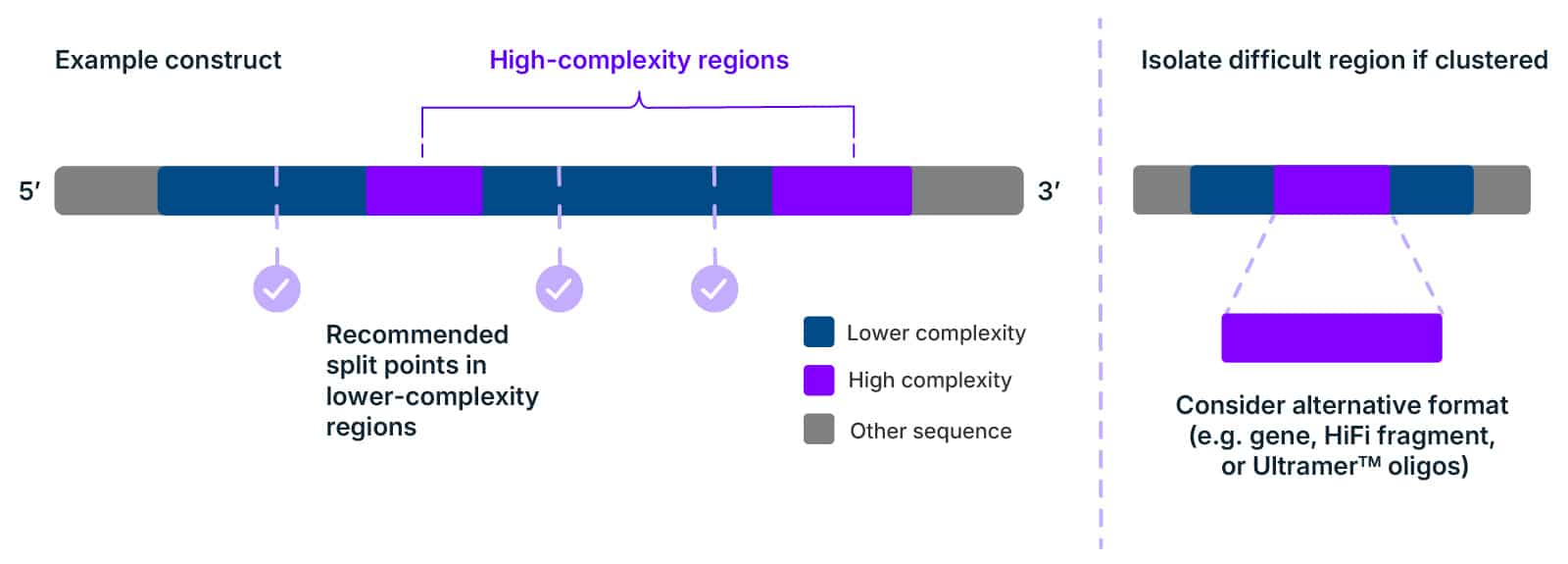
When splitting a sequence, place junctions in lower-complexity regions and outside critical functional elements whenever possible. This can improve both manufacturability and downstream assembly. If complexities are densely clustered within a specific region, consider separating the highly complex segment from adjacent lower-complexity sequence. This approach may allow most of the construct to be manufactured using standard methods while enabling targeted redesign or an alternative synthesis strategy for the challenging region.
Because individual fragments must ultimately be reassembled to recreate the intended construct, design compatible overlaps, cloning sites, and assembly junctions before ordering. Careful planning helps preserve construct function while improving the likelihood that each fragment can be manufactured successfully.
Option 3: Revise terminal-end design for linear DNA fragments
For linear DNA products, including gBlocks™ Gene Fragments, eBlocks™ Gene Fragments, or gBlocks™ HiFi Gene Fragments, manufacturability issues can sometimes be linked to sequence features near the fragment boundaries.
When terminal regions are the likely source of difficulty, revising the fragment ends may help reduce end-related synthesis challenges. Depending on the application, this may involve adding short terminal adapters, extending the fragment to include additional flanking sequence, shortening the fragment to remove a problematic terminal feature, or redesigning terminal regions to reduce GC extremes, repeats, secondary structure, or other challenging sequence characteristics.
For assembly-based workflows, incorporating additional sequence from a surrounding plasmid backbone or natural genomic context may provide more favorable terminal regions for synthesis and downstream assembly. Similarly, when designing positive qPCR controls, non-essential flanking sequence can sometimes be used to improve manufacturability while preserving assay-critical regions.
Custom terminal sequences should generally follow primer-like design principles and avoid introducing new complexity, such as extensive repeats, strong secondary structure, or self-complementarity.
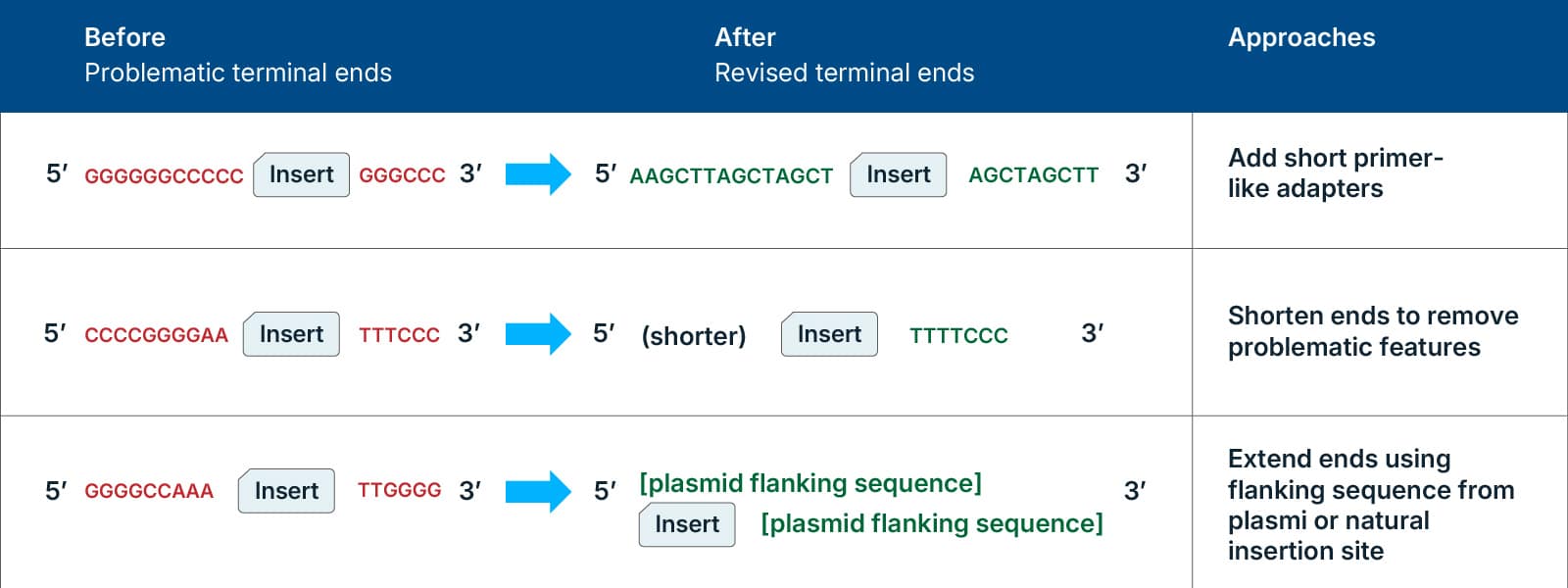
Whether using existing termini or introducing new terminal sequences, primer-like design criteria are generally recommended:
- Approximately 25–30 bp in length
- Around 50% GC content
- Minimal repetitive motifs
- Limited secondary structure potential
- Minimal self-complementarity
These characteristics can improve manufacturability and downstream performance by creating terminal regions that function as effective primer-binding sites while minimizing additional sequence complexity.
For projects that include multiple related constructs, consider using a consistent set of optimized terminal sequences when appropriate. Standardized terminal designs can simplify sequence design, support downstream assembly workflows, and help maintain consistent manufacturability across constructs intended for the same application.
Option 4: Consider an alternative synthesis product format
If redesign or splitting is not enough, another synthesis format may be a better fit.
If a linear fragment remains difficult to produce, a cloned gene in a plasmid may provide another route. For sequences greater than 1 kb, gBlocks HiFi Gene Fragments may also be a better fit. Both custom genes and HiFi fragments include NGS-based sequence verification and use manufacturing approaches that can help recover a correct full-length product from complex or mixed assembly outcomes.
For shorter challenging regions, Ultramer™ DNA Oligonucleotides may also be useful as standalone components or as part of a larger assembly strategy. In some cases, combining multiple product formats—for example, using an Ultramer for a highly complex region and gene fragments for the remaining sequence—can be a practical way to build difficult constructs.
In short: redesign when sequence modifications are acceptable, split or isolate complex regions when construct architecture allows, revise terminal ends when boundary sequences contribute to manufacturability challenges, select alternative or mixed synthesis formats when needed, and consider existing template sources for difficult sequences that are not easily redesigned.
Option 5: Consider sourcing the sequence from an existing template
If a problematic sequence already exists in a plasmid, cell line, genomic DNA sample, or other biological source, obtaining the sequence from an existing template may be more practical than extensive redesign. This approach can be particularly useful for highly constrained elements such as promoters, regulatory regions, or other sequences that must remain unchanged. Examples may include commonly used elements such as CMV or CBA promoters. When appropriate, template-derived sequences can also be combined with synthetic components to create the final construct.
What if my sequence looks low complexity but synthesis still fails?
Sequence analysis tools can identify many features known to increase synthesis difficulty, including extreme GC content, repetitive regions, predicted secondary structure, and challenging terminal sequence composition. These tools are valuable for identifying potential manufacturability concerns and guiding redesign decisions.
However, complexity scores should be viewed as indicators of known risk factors rather than guarantees of manufacturing success. Some sequence challenges arise from combinations of multiple features that may individually appear insignificant but together create synthesis barriers. In other cases, naturally occurring sequence characteristics may affect manufacturability in ways that are not fully captured by current prediction methods.
As a result, a sequence that appears to have relatively low predicted complexity may still prove difficult to synthesize. Receiving a manufacturability warning or cancellation notice does not necessarily mean the original design was flawed. Instead, it may indicate an opportunity to revisit the sequence and identify design changes that improve manufacturability while preserving the intended function.
Even modest adjustments can sometimes make a meaningful difference. Consider reviewing the sequence for localized GC-rich or GC-poor regions, repetitive elements, terminal complexities, or other features that could be modified without affecting critical biological function. If redesign options are limited, alternative approaches such as fragment subdivision, terminal-end optimization, a different synthesis format, or obtaining the sequence from an existing biological template may provide a practical path forward.
Important: Complexity analysis tools are designed to identify and evaluate known synthesis risk factors. While they can be extremely helpful for guiding design decisions, no analysis method can fully predict manufacturing outcomes for every sequence.
Avoid these common redesign mistakes
Small changes can help, but they can also introduce new issues. Before submitting a revised order, avoid these common pitfalls:
- Changing functional sequence unintentionally: Make sure optimization, adapter design, or fragment splitting does not alter required motifs, reading frame, tags, regulatory elements, or assay-specific regions.
- Splitting fragments without an assembly plan: Confirm overlaps, restriction sites, orientation, and junction sequences before ordering separate components.
- Creating new problems while solving old ones: When revising terminal ends, check for repeats, secondary structure, self-complementarity, restriction site conflicts, and compatibility with downstream assembly or cloning workflows.
- Choosing a format based only on length: Product selection should account for sequence composition, verification needs, downstream workflow, and whether the construct is coding or noncoding.
- Overlooking downstream use: Confirm that the revised design still supports cloning, expression, screening, or functional testing requirements.
- Skipping documentation*: Record what changed and why so the redesigned construct remains traceable to the original experimental goal.
* Final designs that were ordered as IDT Synthetic Biology products can be found using the Genes & Gene Fragment Order tool.
Key takeaways
- Difficult-to-synthesize DNA sequences are often linked to extreme GC content, repeat-rich regions, stable secondary structures, or challenging terminal composition.
- The best strategy depends on where the issue occurs and how much design flexibility is available.
- Codon optimization may help coding sequences; noncoding designs often require targeted changes that preserve functional motifs.
- Fragment subdivision, terminal adapters, or another synthesis format may help when redesign alone is not the best fit.
- Before reordering, confirm that the revised design preserves critical elements, supports downstream use, and remains traceable to the original goal.
Still unsure? Get help choosing a path forward
Not sure which route is right for your sequence? Share your construct details, product type, and downstream workflow with IDT applications support. The team can help identify whether redesign, fragment subdivision, terminal adapters, or another format is the most practical next step.
When contacting support, it may help to include:
- The sequence or order context, including the intended application (for example, cloning, expression, genome editing, or qPCR control design) and target organism
- The product format you originally selected
- Whether the sequence is coding or noncoding
- Any required motifs, tags, restriction sites, or assembly overlaps
- Your intended downstream workflow
Manufacturing challenges do not always require starting over. With the right redesign strategy, synthesis approach, or source material, you can often preserve your experimental goals and continue moving your project forward.
For research use only. Not for use in diagnostic procedures. Unless otherwise agreed to in writing, IDT does not intend these products to be used in clinical applications and does not warrant their fitness or suitability for any clinical diagnostic use. Purchaser is solely responsible for all decisions regarding the use of these products and any associated regulatory or legal obligations.